As a sole trader, every single dollar you spend to earn an income is a potential tax deduction. Think of it this way: tax deductions are essentially refunds on your legitimate business costs. The Australian Taxation Office (ATO) lets you claim this money back because it was necessary to run your business, which in turn lowers your taxable income and keeps more cash in your pocket.
Getting your head around the rules is the key to holding onto more of your hard-earned money.

Your Guide to Sole Trader Tax Deductions
Running your own show is incredibly rewarding, but let's be honest—navigating tax time can feel like a whole other job. This guide is your no-nonsense map to understanding every tax deduction you can claim as a sole trader in Australia. We're here to demystify the rules and show you exactly how to legally lower your tax bill.
Our goal is simple: to help you feel confident managing your taxes. We'll start with the core principles the ATO lives by, then jump straight into the specific expenses you can claim.
What This Guide Covers
This is a comprehensive breakdown designed to give you a clear, practical understanding of what you can and can't claim. For many sole traders, the yearly task of claiming deductions is directly tied to using professional tax preparation services to get it right.
Here’s a sneak peek at what you’ll learn:
- Core Principles: The three golden rules from the ATO that every single business expense must meet.
- Common Expenses: A detailed look at the everyday running costs, from your office supplies to marketing campaigns.
- Major Claims: How to correctly calculate and claim those big-ticket items like your home office and vehicle.
- Assets and Super: Getting to grips with depreciation, the instant asset write-off, and claiming your super contributions.
By the time you're done, you'll have a solid game plan for maximising your return. For more tips, check out our related article on how to reduce taxable income. This guide will arm you with the knowledge to hit the end of the financial year with a clear strategy, ensuring you keep more of what you earn.
The Three Golden Rules for Claiming Any Expense
Before you even think about claiming a single dollar on your tax return, you need to get your head around the Australian Taxation Office's (ATO) core principles. Forget all the intimidating jargon for a moment; claiming deductions as a sole trader really just boils down to three simple tests.
Think of these as the foundation of your entire tax strategy. If an expense ticks these three boxes, you can feel confident claiming it. Getting this right is the key to legally maximising your refund and keeping your records audit-proof.
Rule 1: The Expense Must Be for Your Business
First and foremost, the expense has to be directly tied to earning your income. It needs to be a genuine cost of running your business, not a personal treat you've tried to sneak in.
Let’s say you’re a freelance graphic designer. Buying a new high-performance laptop is a clear-cut business expense because it’s the tool you need to create designs for clients and get paid. But picking up a new gaming console, even if you keep it in your home office, is a private expense. You can't claim it.
The ATO's guiding question is refreshingly simple: "Did you spend this money to help your business generate income?" If the answer is a definite "yes," you’ve passed the first test.
Rule 2: You Must Have Proof of Purchase
The second golden rule is all about evidence. You can't just tell the ATO you spent money on something; you have to be able to prove it if they ask. Your records are your defence.
This means getting organised and keeping solid documentation for every business purchase.
- Receipts and Invoices: These are your best friends. They show exactly what you bought, when you bought it, and how much you paid.
- Bank Statements: Your credit card and bank statements are great for backing up your claims by showing the transaction actually happened.
- Contracts: For bigger, ongoing costs, agreements with clients or suppliers can also serve as proof.
Without that paper trail, your claim is just a guess in the ATO's eyes, and they have every right to disallow it.
Rule 3: You Can Only Claim the Business Portion
The final rule tackles those expenses that pull double duty—partly for business, partly for personal life. For these mixed-use costs, you can only claim the business-use percentage. This is a process called apportionment, and it's something every sole trader needs to master.
Your mobile phone is the perfect example. Let's say your bill is $100 a month. To figure out your claim, you keep a log for a representative period (like a month) and find you use your phone 70% of the time for work-related calls and data, and the other 30% is for scrolling through social media or calling your mum.
You can only claim the business portion of that bill.
The calculation is straightforward: $100 (monthly bill) x 70% (business use) = $70 claimable expense per month.
This same principle applies to many common deductions, like your car, internet, and home office costs. Stick to these three rules, and you'll be well on your way to lodging an accurate, defendable tax return.
Claiming Your Day-To-Day Business Operating Costs
It’s the small, everyday expenses that often get missed when sole traders tally up their deductions. While a single purchase might not seem like much, these little costs can add up to a significant tax saving over the financial year. This section is your checklist for these common operating costs, making sure you claim every dollar you're entitled to.

Think of these expenses as the fuel that keeps your business engine ticking over. They aren't about creating a new asset; they're the costs of handling the day-to-day activities that bring in your income. The real key here is to be meticulous with your records for every single transaction, no matter how small.
Office and Administrative Essentials
These are the nuts and bolts of running your workspace and keeping the admin side of things in check. They're often frequent, low-value purchases that are all too easy to forget, but they're absolutely essential for your operations.
- Stationery: This covers everything from pens, paper, and notebooks to folders and printer ink.
- Printing and Photocopying: Any costs for printing client proposals, invoices, or marketing flyers are fully deductible.
- Postage: If you use mail or courier services for business, you can claim it.
- Software and Subscriptions: This includes your accounting software (like Xero or MYOB), project management tools (like Asana), cloud storage, and any other business-related digital subscriptions.
A simple trick to make tracking these smaller expenses a breeze is to maintain a dedicated business bank account. It creates a clear line between your business and personal spending, which saves a world of headaches at tax time. For more on getting your finances in order, check out our top small business bookkeeping tips to keep everything organised.
Marketing and Advertising Costs
You've got to spend money to make money, right? Getting your name out there is crucial for attracting clients and growing your business. The good news is that pretty much all the costs tied to promoting your services are legitimate tax deductions for a sole trader because they're directly linked to generating new income.
Here are a few examples of marketing costs you can deduct:
- Website Expenses: This includes your domain name registration, annual web hosting fees, and any money spent on website developers or designers.
- Digital Advertising: The cash you splash on Google Ads, social media campaigns (Facebook, Instagram, LinkedIn), and other online ads is claimable.
- Traditional Advertising: Costs for printing flyers, business cards, or running ads in local papers also count.
- SEO Services: Fees paid to a consultant or agency to help you climb the search engine rankings are a valid business expense.
Professional Fees and Financial Costs
As a sole trader, you often need to lean on expert advice and financial services to stay compliant and run your business efficiently. These professional fees are directly related to managing your business, making them deductible.
Paying for professional help isn't just a cost; it's an investment in your business's financial health and compliance. The fees you pay an accountant or bookkeeper to manage your tax affairs are, in themselves, a tax deduction.
Here’s a breakdown of the common professional and financial expenses you can put on your claim list:
Financial Institution Fees
- Bank Fees: Those monthly account-keeping fees on your dedicated business bank account are deductible.
- Loan Interest: You can claim the interest charged on business loans, which includes overdrafts and credit cards used for business. Just remember, you can only claim the interest portion, not the principal repayments themselves.
- Transaction Fees: Any fees charged by payment gateways like Stripe or PayPal for processing client payments are also claimable.
Professional Services and Memberships
- Accounting and Bookkeeping Fees: The cost of hiring an accountant or bookkeeper to prepare your BAS or annual tax return is 100% deductible.
- Legal Fees: Got to pay for legal advice on your business operations, like a contract review? That's claimable.
- Professional Memberships: Fees for joining an industry association relevant to what you do are deductible. For example, a graphic designer can claim their membership to the Australian Graphic Design Association (AGDA).
- Business Insurance: Premiums for policies like public liability or professional indemnity insurance are essential operating costs and are fully deductible.
How to Claim Home Office and Vehicle Expenses Correctly
Your home office and vehicle are often two of the biggest sources of tax deductions for a sole trader, but they’re also the most scrutinised by the ATO. Nailing these claims is all about understanding the different methods available and picking the one that best reflects how you actually run your business. Get it right, and you can significantly lower your tax bill. The catch? It all hinges on diligent record-keeping.
Let's break down the ATO-approved methods for both home office and vehicle expenses. With clear, practical examples, you’ll see exactly how to apply these rules and maximise your claims without crossing any lines.
Think of your business costs like this: if it's a simple, day-to-day running cost, it's usually a straightforward deduction. Easy.
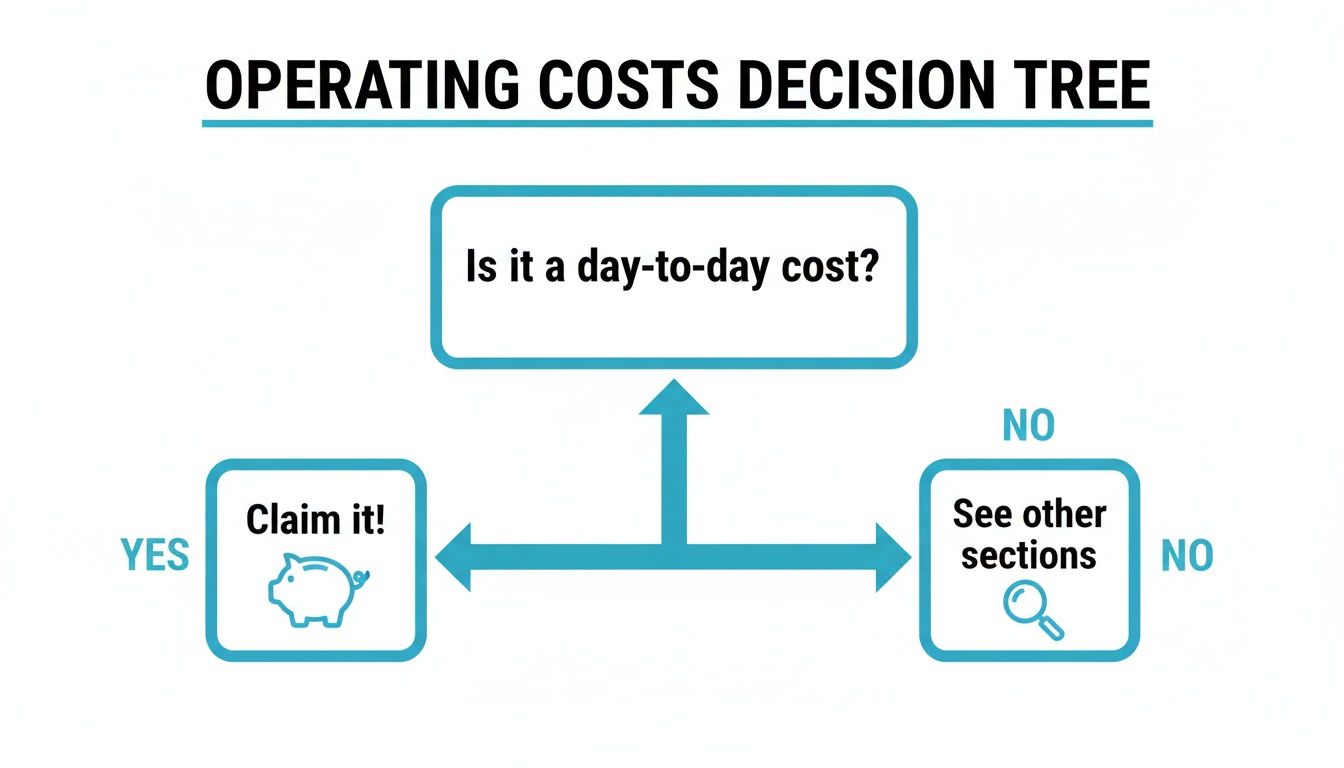
This simple chart reinforces the idea. Regular operating expenses are the low-hanging fruit. It’s the larger, mixed-use costs—like your car and home—that need a bit more attention, which is what we'll dive into now.
Decoding Your Vehicle Expense Claims
When you use your car for business—whether it's driving to meet clients, picking up supplies, or travelling between job sites—those running costs are absolutely a valid tax deduction. The ATO gives you two distinct ways to calculate your claim.
Method 1: The Cents Per Kilometre Method
This is the simpler of the two options, tailor-made for sole traders who don't live in their car but use it for work from time to time. It lets you claim a set rate for every business-related kilometre you drive, no mountain of receipts required.
- How it works: You can claim a maximum of 5,000 business kilometres per car, each financial year.
- The rate: The ATO sets a rate per kilometre annually (for example, 85 cents for the 2023–24 financial year). This single rate is designed to cover everything—fuel, registration, insurance, and even depreciation.
- Record-keeping: While you don’t need a receipt for every litre of petrol, you do need to be able to show the ATO how you worked out your kilometres. A simple diary or calendar noting your work-related trips is usually enough.
This method is perfect if you mainly use your personal car and just need it for occasional business trips. It’s low-admin, but that 5,000 km cap means you could be leaving money on the table if you drive a lot for work.
Method 2: The Logbook Method
If your car is a core part of your business operations, the logbook method will almost certainly deliver a much bigger tax deduction. It's more work, there’s no denying it, but it provides a more accurate—and often much more generous—claim based on your car’s actual running costs.
Here’s what you need to do:
- Keep a Logbook: You must keep a detailed logbook for a continuous period of at least 12 weeks. This logbook needs to capture your odometer readings, the date, and the purpose of every single business journey.
- Calculate Your Business-Use Percentage: Once the 12 weeks are up, you use that data to calculate the percentage of your car's total travel that was for business. The great part is this percentage is then valid for up to five years, as long as your driving habits don't drastically change.
- Track All Car Expenses: This is where the diligence comes in. You need to keep receipts for all vehicle costs for the entire year. We’re talking fuel, oil, registration, insurance, servicing, and even car washes. For bigger jobs like maintenance, using a professional automotive repair receipt template can ensure you capture all the necessary details the ATO looks for.
With this method, you claim your calculated business-use percentage of all your car expenses, including depreciation on the vehicle's purchase price.
Calculating Your Home Office Deductions
Working from home is the new normal for countless sole traders, making the home office deduction more critical than ever. Just like with vehicle costs, the ATO offers two main methods to calculate what you can claim.
A crucial point to grasp is the difference between 'occupancy expenses' (like rent or mortgage interest) and 'running expenses' (like electricity and internet). As a sole trader, you can generally only claim the running expenses. The only exception is if your home is officially your principal place of business and you have a specific area used exclusively for that work.
Method 1: The Fixed Rate Method
This is the ATO’s simplified, all-inclusive shortcut. From 1 July 2022, a revised fixed rate (for example, 67 cents per hour) was introduced to cover your main home office running costs in one go.
- What it covers: This single rate bundles up your electricity and gas, phone and internet usage, stationery, and computer consumables.
- What it doesn't cover: You can still make separate claims for the decline in value (depreciation) of your office equipment and furniture, as well as any specific repairs.
- Record-keeping: You must keep a record of the total number of hours you worked from home for the entire year. A timesheet, diary, or calendar entries will do the trick. You also need to hang on to at least one quarterly bill for each expense type included in the rate (like one electricity bill, one phone bill) to prove you actually incurred those costs.
Method 2: The Actual Cost Method
This method involves calculating the real, business-related portion of every expense you incur from running your business at home. It demands more detailed records, but it can result in a much larger deduction if your costs are significant.
You’ll need to work out the business portion of each specific expense.
- Running Expenses: You’ll need to calculate the business-use percentage for costs like power, gas, and internet. A common way to do this is by working out the floor area of your dedicated office space as a percentage of your home's total area.
- Depreciating Assets: You can claim the decline in value for office workhorses like your computer, desk, and chair.
- Record-keeping: This method is all about the details. You must keep every single receipt and bill, along with a clear calculation showing how you apportioned the private versus business use for each and every expense.
A bit of careful planning now can make a world of difference at tax time. For a deeper dive, check out our end of financial year checklist for small business to make sure you’ve got all your bases covered.
Claiming Tools, Equipment, and Depreciating Assets
While day-to-day operating costs are a huge part of your deductions, what about the bigger ticket items? The new laptop, specialised machinery, or professional camera gear you need to get the job done are handled a bit differently by the ATO. These are your business assets, and you claim their cost over time through a process called depreciation.
Think of it like this: an asset loses value as it gets older and wears out. So, instead of claiming its entire cost in the year you buy it, the ATO lets you deduct a slice of its value each year over its "effective life." This approach is meant to reflect how the asset contributes to your business over several years, not just one.
But for sole traders and other small businesses, there are some seriously powerful rules that let you fast-track this process, giving you a significant cash-flow boost right when you need it most.
The Power of the Instant Asset Write-Off
One of the most valuable tools in a sole trader's tax kit is the instant asset write-off. This scheme lets you skip the slow drip of depreciation and claim the full business portion of an asset's cost in the same financial year you start using it. It's a fantastic way to immediately slash your taxable income.
For the 2024-25 financial year, small businesses with an aggregated turnover under $10 million can immediately write off the full value of eligible assets costing less than $20,000. The key is that the asset must be first used or installed ready for use between 1 July 2024 and 30 June 2025. You can learn more about the specifics of the instant asset write-off and how it can work for you.
This rule is an absolute game-changer. It means if you buy a necessary piece of equipment, you get the full tax benefit upfront, which can make a massive difference to your cash flow for that year.
Let's look at a practical example to see it in action.
Example: A Photographer's New Gear
Imagine you're a freelance photographer. In August, you splash out on new camera equipment for $8,500, and it's used 100% for your business.
- Without the write-off: You'd have to depreciate the gear over several years, only claiming a small fraction of its cost each year.
- With the write-off: Because the cost is under the $20,000 threshold, you can claim the entire $8,500 as a tax deduction in that same financial year. This immediately drops your taxable income by $8,500, leading to a much smaller tax bill.
That immediate deduction frees up cash you can pump straight back into your business, whether that’s for marketing, training, or other essential costs.
Understanding Simplified Depreciation Pools
So, what happens if an asset costs more than the instant asset write-off threshold? Or what if you decide not to use the write-off for a specific item? These assets are usually bundled into what the ATO calls a small business simplified depreciation pool.
Think of this pool as one big bucket where you put all your higher-value business assets. Instead of having to track the depreciation for every single item separately, you just claim a deduction based on the total value of the pool. It makes the bookkeeping so much simpler.
Here’s the breakdown:
- First Year Rate: For any new assets you add to the pool, you can claim a deduction of 15% of their business-use cost in that first year.
- Subsequent Years Rate: For assets already in the pool, you can claim a deduction of 30% of the pool's opening balance in the following years.
The simplified depreciation pool is a practical way to manage deductions for assets that don't qualify for an immediate write-off. It ensures you can still claim their value over their useful life without getting bogged down in complex individual calculations.
Super Contributions and Other Powerful Deductions
Beyond the usual day-to-day running costs, there are a few heavy-hitting deductions that can make a massive difference to your tax bill. These are the strategic moves that not only deliver a short-term win but also bolster your long-term financial security. At the top of that list is superannuation.
As a sole trader, you don’t have an employer paying your super guarantee. That’s all on you. But this responsibility comes with a fantastic tax perk: you can make personal contributions to your super and claim them as a tax deduction.
Claiming Personal Super Contributions
Making personal super contributions is genuinely one of the smartest things you can do. You’re lowering your taxable income right now while simultaneously building up a nest egg for your future. It's a classic win-win that turns saving for retirement into an immediate tax break. The process is pretty straightforward, but you absolutely have to follow the right steps.
For sole traders, this is how you can supercharge your retirement savings. The annual concessional (before-tax) contributions cap is $30,000 for the 2025-26 financial year. The money you contribute is taxed at just 15% inside your super fund, which is almost always a much friendlier rate than your personal marginal tax rate. Since you’re funding your own retirement, this deduction makes saving for it incredibly tax-effective. To get the deduction, you need to get the money into your fund by 30 June and send a 'notice of intent' form to your super fund. You can discover more insights about super contributions on SuperGuide.
Important Steps Before Claiming Your Deduction
- Make the Contribution: Before the 30 June deadline, transfer the money from your business or personal account into your chosen super fund.
- Submit a 'Notice of Intent': This is the crucial step. You have to formally tell your super fund that you plan to claim a tax deduction for the amount you put in. They'll have a specific form for this, usually called a 'Notice of intent to claim or vary a deduction for personal super contributions'.
- Get the Acknowledgement: Your super fund will send you a letter or email confirming they've received your notice. Do not lodge your tax return until you have this confirmation in your hands.
- Claim the Deduction: When you're lodging your tax return, you’ll include the contribution amount in the section for personal super contribution deductions.
By funnelling pre-tax income into your super, you effectively reduce your taxable income dollar-for-dollar, resulting in a lower tax bill for the financial year. It's a powerful financial lever every sole trader should consider using.
Other Valuable Deductions You Might Be Missing
Super isn't the only big-ticket item. Plenty of other significant expenses can be claimed, but they're often overlooked by sole traders who leave money on the table that is legally theirs.
Professional Development and Training
Self-education: Any costs for courses, seminars, or workshops that are directly related to your current business and help you maintain or improve your skills are deductible. Think of a digital marketing course for a freelance writer or a new software training program for a graphic designer.
Business Travel Expenses
Overnight Stays: If your work requires you to travel and stay somewhere overnight, you can claim the costs of your accommodation and meals. This is a specific exception to the rule, as your regular daily coffee and lunch are generally not deductible.
Essential Insurance Premiums
Business Insurance: The annual premiums you pay for policies that protect your business are 100% deductible. This covers things like public liability insurance, professional indemnity insurance, and insurance on your business tools and equipment.
Got Questions? Let's Unpack Some Common Sole Trader Deduction Scenarios
When you're out in the real world running your business, tax rules aren't always black and white. You run into tricky situations that need a bit more clarity. Let's tackle some of the most frequent questions we hear from sole traders.
Can I Claim My Coffee or Lunch Meeting as a Deduction?
This is probably one of the most common questions, and the short answer is almost always no. Unfortunately, the ATO is pretty clear on this one: they see meals, coffees, and general entertainment expenses as private, even if you're deep in a business chat with a client.
The only real exception is if you're travelling for work and have to stay away from home overnight. In that specific scenario, the cost of your meals becomes part of your deductible travel expenses. But for day-to-day client lunches or grabbing a coffee? That one’s on you.
What if I Use Something for Both Work and Personal Life?
This is the reality for most sole traders, and the ATO has a straightforward rule: you have to split, or apportion, the cost. You can only claim the business-use percentage of any expense.
Think about your phone, your laptop, or your car. If you figure out that you use your mobile phone 60% of the time for business calls, emails, and admin, you can only claim 60% of your monthly bill. The same goes for the phone's depreciation – you can only claim 60% of that, too.
So how do you prove it? The best way is to keep a logbook or diary for a representative period, like four weeks, to establish a clear pattern of business vs. personal use. That little bit of record-keeping is your best defence if the ATO ever asks you to justify your claim.
How Long Do I Need to Keep All This Paperwork?
The magic number here is five years. The ATO requires you to hang onto all the financial records that back up your tax claims for a full five years, starting from the day you lodge your tax return.
Record-keeping: Make sure you have an organised system for all your receipts, invoices, bank statements, and logbooks for at least five years. Going digital is a game-changer here. Using cloud accounting software is a brilliant way to keep everything secure, organised, and easy to find when you need it.
At Trew North Accounting, we live and breathe this stuff. We specialise in helping Aussie sole traders and small businesses navigate their tax obligations without the headache. Our team can give you the expert guidance you need to make sure you're claiming every single dollar you're entitled to. If you could use a hand with your tax planning or bookkeeping, head over to Trew North Accounting and see how we can help.